
Request A Demo

Thank you! Your submission has been received!
Oops! Something went wrong while submitting the form.

When evaluating digital transformation, construction companies typically focus on the immediate benefits to individual projects: saving time, reducing paperwork, improving communication, minimizing errors, and enabling faster decisions.
However, the value does not stop at the project level. When better digital practices are applied consistently across multiple teams and projects, their benefits begin to accumulate. The broader value of digital transformation can therefore be examined at three interconnected levels: the company, the construction industry, and the wider economy.

When these benefits are repeated across teams and projects, they become organizational capabilities.
A digitally mature contractor can develop a more consistent approach to collecting information, managing responsibilities, escalating risks, monitoring performance, and retaining project records. The company becomes less dependent on individual memory and personal effort. This is particularly important when experienced employees leave. If critical knowledge exists only in their inboxes, spreadsheets, WhatsApp conversations, or memory, much of that knowledge leaves with them.
When project data is structured and retained, the organization can:
The intangible benefit is organizational learning. The long-term business value is a company that becomes more consistent, resilient, scalable, and less vulnerable to the loss of individual employees.

The same principle applies across the construction industry.
Construction projects are delivered by networks of clients, consultants, contractors, subcontractors, suppliers, and authorities. Each organization may use different systems, terminology, reporting formats, and methods of managing information. This fragmentation limits collaboration and makes it difficult to build knowledge from one project to the next.
Wider adoption of structured digital practices can help the industry develop clearer data standards, more transparent workflows, and stronger institutional knowledge.
Over time, this can lead to:
It can also make construction more attractive to skilled professionals.
Talented employees are less likely to remain motivated in workplaces where large portions of their time are consumed by repetitive reporting, searching for information, correcting avoidable errors, and following up on routine actions. Over time, as people become more familiar with digital workflows and experience their benefits, resistance gradually gives way to acceptance and adoption. What initially appears to be an optional change can eventually become embedded in the organizational culture—the expected and preferred way of working rather than a negotiable addition.
The economic impact becomes clearer when we consider the scale of construction. Infrastructure, housing, industrial facilities, utilities, transportation systems, hospitals, and schools all influence economic and social development.
When a project is delayed, the impact is not limited to additional project overhead. The intended asset also begins delivering its economic or social benefit later. A school delivered sooner may allow children to study within their neighborhood, reducing long commutes for both students and parents. Residential developments completed earlier can enable families to find homes closer to their workplaces, saving commuting time and allowing parents to spend more time with their families, while hospitals delivered sooner can begin treating patients and expanding access to healthcare. Each completed asset enables other activities, opportunities, and services, creating a ripple effect across communities and the wider economy.
When projects suffer rework, inefficient coordination, or disputes, labor and capital are consumed without creating equivalent additional value. Public and private resources that could have funded other investments are instead used to correct mistakes or resolve disagreements.
McKinsey Global Institute estimated that if construction productivity caught up with the productivity of the overall economy, the sector could generate approximately $1.6 trillion in additional value annually—an amount equivalent to about 2% of global GDP at the time of the study.[1]
Digital transformation alone will not close the entire productivity gap. Improvements are also required in procurement, contracting, design, supply-chain integration, skills, project management, and regulation.
However, connected data and effective digital workflows are important enablers. They help organizations coordinate work, understand performance, identify problems earlier, and learn from previous projects.
When repeated across thousands of projects, relatively small improvements in decision-making, communication, productivity, and error reduction can create substantial economic value.
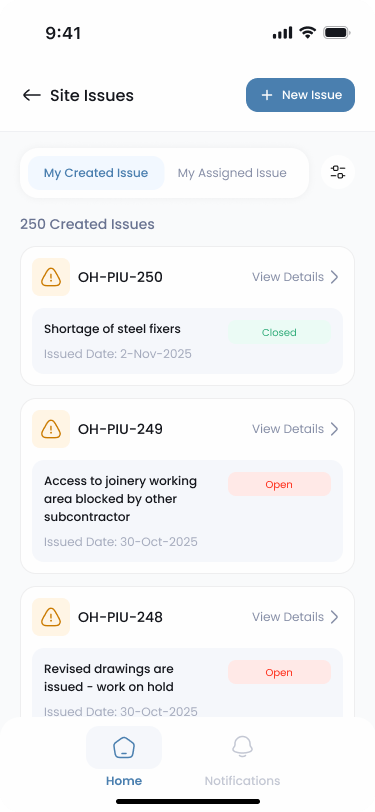
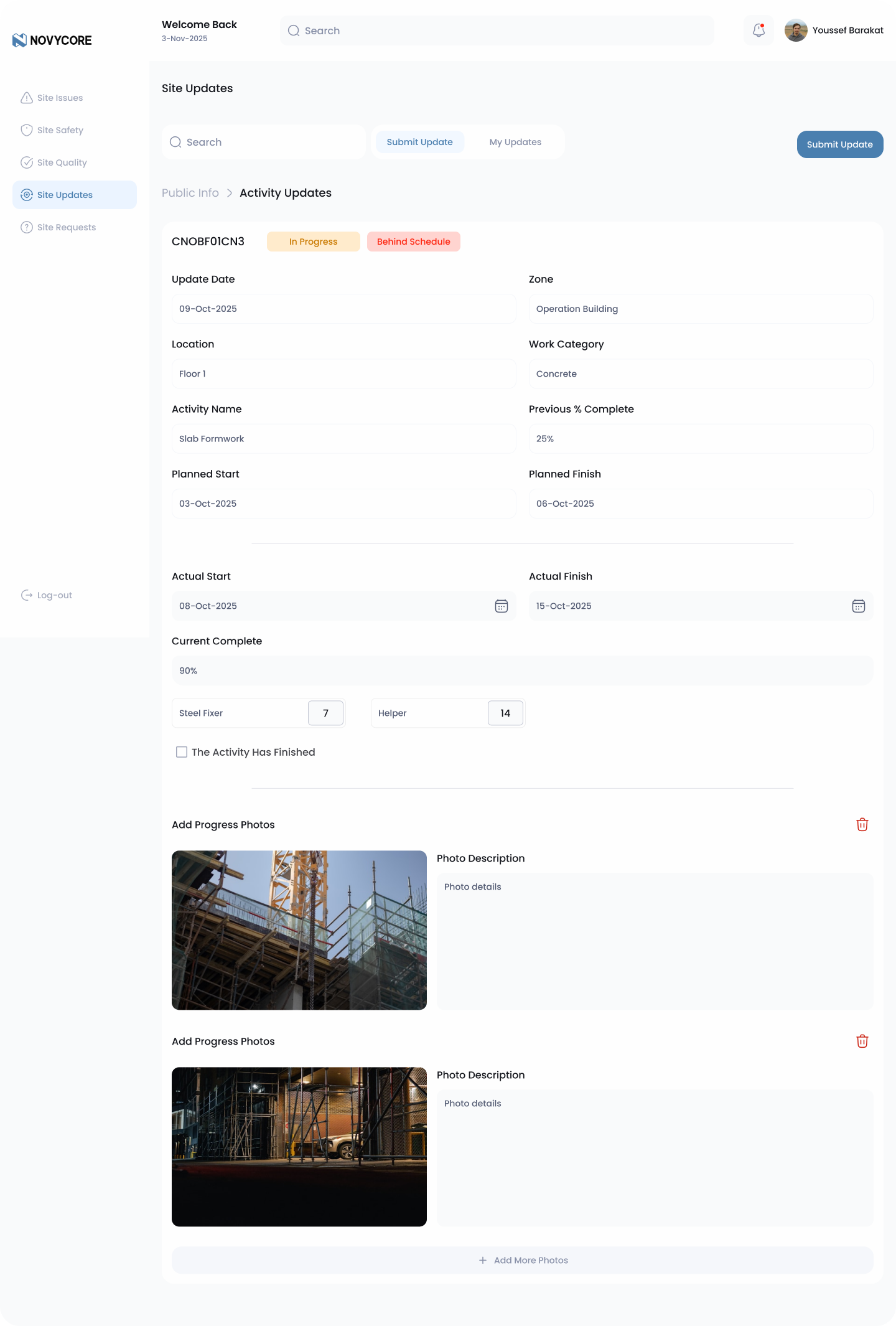
Digital transformation should not be understood as purchasing software or reproducing existing paper forms on a screen. Its purpose is to improve how information moves through the organization and how people use that information to coordinate work, manage risks, and make decisions.
Whether the focus is site updates, issues, quality, safety, documents, requests, or analytics, the objective is not simply to digitize isolated activities. It is to create connected workflows that provide clearer information, reduce unnecessary effort, and support better decisions. The most meaningful transformation occurs when the technology becomes almost invisible because the work itself has become clearer, calmer, and more effective. The most meaningful transformation occurs when technology becomes almost invisible because the work itself has become clearer, more coordinated, and more effective.
The initial improvements may seem small or difficult to quantify. However, when they are repeated across teams, projects, and organizations, their value compounds. They influence productivity, rework, employee retention, project performance, dispute resolution, organizational resilience, industry capability, and the economic value generated from construction investment.

Companies must therefore be willing to take a long-term view. Digital transformation does not deliver its full value immediately after a new system is introduced. Its benefits mature as employees adopt the workflows, reliable data accumulates, processes become more consistent, and the organization learns how to use its information more effectively.
References
