
Request A Demo

Thank you! Your submission has been received!
Oops! Something went wrong while submitting the form.

What if I told you that rushing all day to finish daily tasks is actually counterproductive in construction projects? You might say, “But Osama, you don’t understand. The workload is huge, and there are too many details.” Progress issues, emails, procurement, subcontractors, reports, meetings, phone calls, client requests, consultant letters, approvals, authorities, drawings, submittals, and documents. Nobody asked for the daily adrenaline rush that exists in construction projects. But is this truly the reality of the industry, or is it simply what we have been conditioned to accept? We never knew another way.
If you watch a movie at 10x speed, you won’t understand it because human consciousness and comprehension are not designed for that pace. We process information at a certain speed. Moreover, humans evolved to interact with a limited number of people at a time, within structured communication rules like one person speaks while others listen. In other words, the pace is controlled.
There are two types of communication: push and pull.
Push communication actively sends information directly to recipients, such as emails, alerts, phone calls, and messages. Pull communication, on the other hand, makes information available for recipients to access on demand.
Construction projects are heavily dominated by push communication. Teams receive endless unexpected phone calls with no time to properly process information or document required actions. Project WhatsApp groups generate continuous streams of messages, most of which are irrelevant to many team members, creating enormous mental noise that the brain continuously tries to process.
The issue is not only the volume of communication. It is the lack of structure.
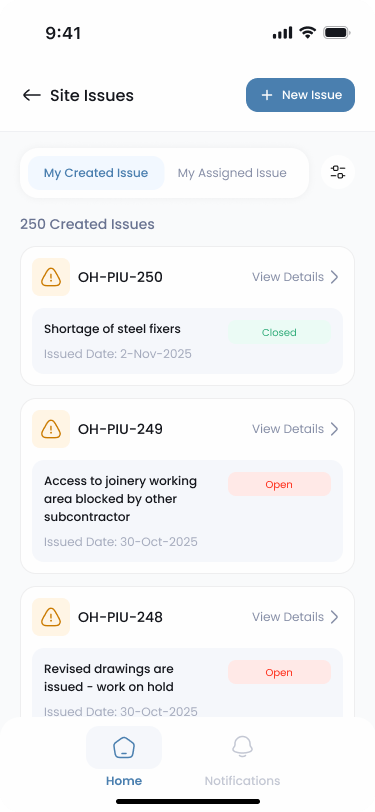
Construction projects need more pull communication. For example, team members should access issues log whenever convenient to log site issues or review issues assigned to them. Construction Managers and Project Managers should be able to view all progress issues grouped by location or activity type so they can deal with them in bulk at predefined times. Procurement officers should process all requests from one organized platform instead of reacting to interruptions throughout the day.
In other words, team members should control the pace and flow of communication — both incoming and outgoing.

Digital transformation initiatives must take the nature of construction work into consideration. For example, company solutions should allow site engineers to spend more time onsite, where they are most productive and focused on actually executing the work. That is why mobile applications should enable engineers to log issues and take actions directly from the field without leaving the site. Moreover, every team member sees only the information relevant to them, helping cut through the noise. Row-Level Security & Access Control rules should also be applied. Each request is linked to its creator, while viewing and editing permissions follow your project’s organizational structure to ensure transparency, accountability and controlled access.
Similarly, procurement engineers repeatedly entering the Project Manager’s office to obtain signatures is another form of push communication that disrupts productivity. Project Managers should focus on high-impact tasks and process requests digitally at their own pace based on their priorities and schedules. As a result, requests and approvals should become fully digital with zero paperwork.

If you panic in water and try to swim with urgency and fear, you will drown. But if you relax, surrender, and move with intention, you float naturally because that is how the human body is designed to operate. The same principle applies to constructionprojects. This does not mean reducing effort. It means directing effort intentionally instead of operating from constant reaction and urgency.
The goal is not to stop working hard. The goal is not reducing effort but directing effort intentionally and optimizing it from a centered, grounded, and aligned state. You invest the same amount of time and effort but achieve significantly higher productivity and deliver greater value. Break the cycle of urgency, overwhelm, rush, constant vigilance, immediate reactions, and endless communication channels that are not designed for human consciousness.
The problem in construction projects is not a lack of data. It is a data structure problem.
That structure affects everything:

One of the main goals when designing digital transformation solutions is to capture data once and use it everywhere across the entire organization. Yes, building proper systems and training teams takes time. But the long-term payoff is enormous. Imagine being so busy that you never organize your desktop or folders. You convince yourself that you do not have time. Yet every time you search for a file, you waste additional time looking for it, interrupt your focus, and increase stress and burnout.
However, the moment you decide to organize your folders properly, you become grateful every single time you need to retrieve a file because of the efficiency, clarity, and peace it creates.
Emails, WhatsApp messages, paperwork, phone calls, and compounded minor interruptions are silently destroying construction team productivity.
Regards,
Osama Saad
